
Grades 2 to 5 · Student age 7 to 11
Today’s free activity needs a pencil, a lump of clay, and a sunny spot. Build a simple shadow clock, then watch the sun’s shadow move and change length through the day. It takes about five minutes to set up and a few quick check-ins to finish.
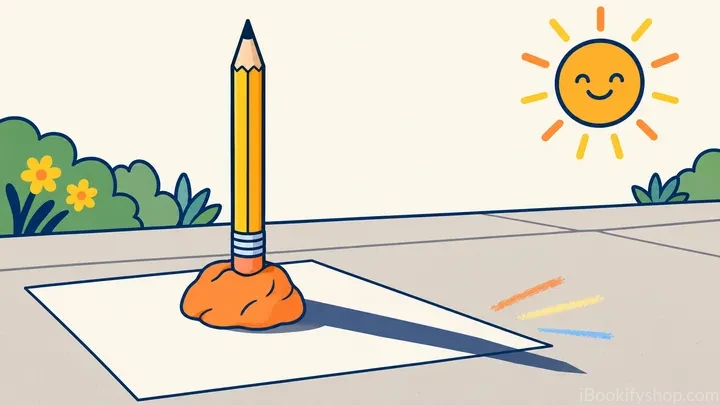
What You Need
- One sheet of paper
- One pencil
- A small lump of modeling clay
- A pen or marker, and a ruler
- A sunny spot outside or by a bright window that stays sunny
Steps
- Place the paper on flat ground in a sunny spot. Tape or weigh down the corners so it cannot move.
- Press the clay in the middle of the paper and stand the pencil straight up in it.
- Trace the pencil’s shadow with a line. Write the time next to the tip of the shadow.
- Come back every hour or two. Trace the new shadow each time and write the time.
- Measure each shadow line with the ruler and write the length beside it.
What to Notice
- Direction: the shadow points away from the sun, so it swings around as the sun seems to move across the sky.
- Length: shadows are long in the morning and late afternoon, and shortest around midday when the sun is highest.
- Pattern: the shadow lines fan out like the hands of a clock. That is why people built shadow clocks, also called sundials, long ago.
Why It Happens
The sun does not really move across the sky. Earth spins once a day, so the sun seems to rise, climb, and set. As the sun’s position changes, the pencil’s shadow changes too.
Go Further
Predict where the shadow will be at the next hour before you check. Then compare your prediction with the real line. Try the same activity on another day and see if the shortest shadow lands at about the same time.
Featured workbook: try the 5th Grade Earth Science Workbook for more practice with Earth, the sun, and the sky.
See the Workbook on Etsy750 questions and answers, printable PDF